A Calm Start to the Owner Manual: Find the Pages You Will Revisit
A model-specific manual becomes easier to use when you locate the practical pages before you need them. Follow one invented scooter owner as they build a short, reliable reference.
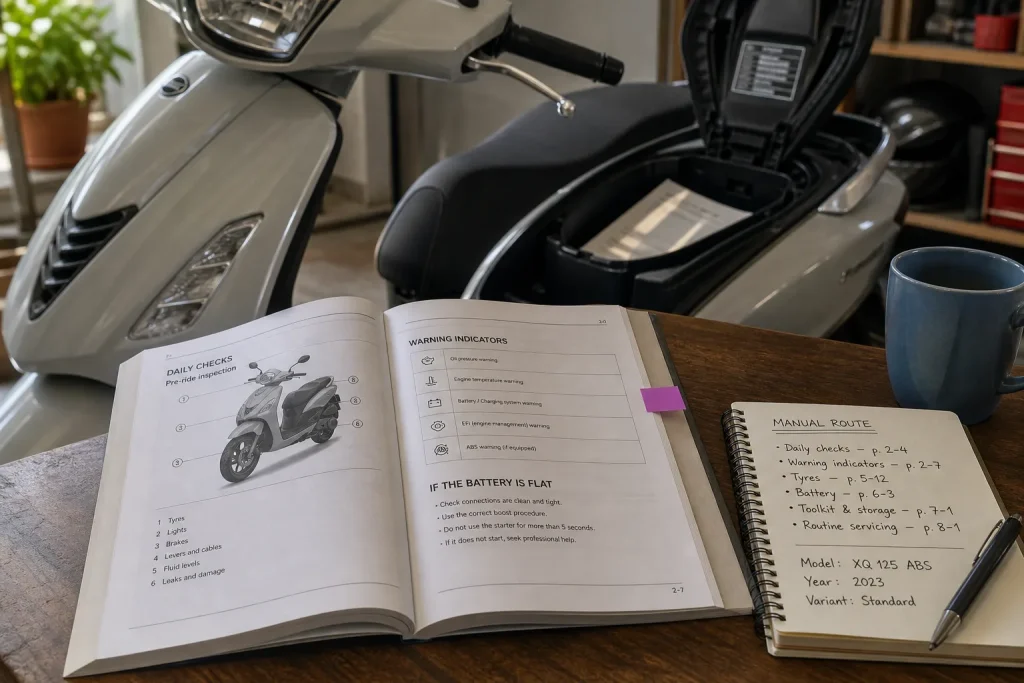
Which pages in your motorcycle or scooter manual will you need again, and how can you be sure they belong to your exact machine? Say you have just brought home a used scooter, the keys are on the kitchen table, and a small warning light has appeared on the display. The manual is in the under-seat compartment, but it is thicker than you expected and its cover looks similar to one shown in an online search. Before guessing, you need to identify the right edition and make a simple route through the information you are likely to revisit.
Imagine that this scooter belongs to Lena, a fictional new owner. She wants to learn where to check the oil, what the dashboard symbols mean, and what to do if the battery goes flat. She does not need to memorise the whole book. Her useful result will be a handful of confirmed pages, easy to find when she is calm, plus a clear sense of when to stop and ask a qualified mechanic.
Confirm the machine
Lena starts with the machine, not a search engine. She checks the make and model name printed on the bodywork, then looks for the model year or variant information in the paperwork and on the vehicle identification plate. The plate may be on the frame, steering head or another location specified by the manufacturer. If she cannot find it, she checks the manual or asks a dealer where that model carries its identification details.
This matters because two scooters with similar names can have different engines, displays, braking systems or service requirements. A manual for a neighbouring model year may be close enough to look convincing while describing a different control or maintenance procedure. Even a trim-level change can affect the equipment fitted. Treat the exact model, year and variant as a set of identifiers, rather than relying on the badge alone.
She compares those details with the manual’s cover and its identification pages. If the book is missing, she searches the manufacturer’s official support site using the full model designation, then checks that the document names the matching year or version. A dealer can help resolve an unclear match. A document-sharing page or owners’ forum may contain useful discussion, but it should not replace the manufacturer’s manual for machine-specific instructions.
There is one more check: the machine may have been altered. A previous owner could have fitted a different battery, exhaust, screen or accessory. If the manual’s diagram does not match what Lena sees, she does not force the two into agreement. She records the difference and asks the seller, a dealer or a qualified mechanic which instructions apply. The book describes the original configuration; the actual machine deserves attention too.
Build a page route
Once Lena is confident about the manual, she flips through the contents page and index. She is not reading from front to back. Instead, she marks the sections that answer practical questions she expects to face. The index helps when she knows a word such as “fuse” or “warning indicator”; the contents page helps when she wants the wider section around that subject.
She makes a short note on the inside cover: the page number for daily checks, the dashboard indicators, tyre information, battery access, the tool kit and routine servicing. She writes the section titles as well as the numbers, because page numbers can differ between a printed book and a digital file. If the manual uses chapter names rather than a clear contents listing, she records those names and the relevant search terms.
A paper manual can take a discreet removable tab on its edge, provided it does not cover a warning or damage the pages. For a digital manual, Lena saves the official file in a clearly named folder on her phone and learns how its search function handles terms. A search for “oil” may bring up several passages; “engine oil level” may lead more directly to the procedure. She keeps the file available offline if the phone allows it, rather than assuming a signal will be there when she needs the information.
Her route is deliberately small. The goal is not to turn the manual into a scrapbook or to mark every page. A few well-chosen references make it easier to locate the right instruction without burying it among notes. She also leaves the warning, safety and maintenance sections unaltered so that she can read the original wording in full.
Read before acting
Lena next checks what each marked section actually says. A heading can sound familiar while the procedure differs from what she expects. For example, the manual may specify a particular stand position, engine condition or inspection order. She reads the full instruction, including the cautions and illustrations, before touching a cap, switch or fastener.
For a basic pre-ride check, she finds the manufacturer’s directions for the tyres, lights, brakes and visible signs of leaks or damage. She notes what the manual tells her to inspect and what condition should prompt further attention. If a check involves lifting a panel, supporting the machine or handling a hot component, she pays attention to the stated precautions. An unfamiliar or awkward procedure is a good reason to pause and seek help, not an invitation to improvise.
The tyre section deserves particular care. Lena records the pressures and checking conditions specified for her exact scooter, if the manual provides them, and notes where the tyre information applies to different loads or riding conditions. She does not copy figures from another model, a general article or a pressure written on a tyre sidewall without understanding its purpose. If the manual, vehicle label and fitted tyres appear to conflict, she asks a dealer or tyre professional to clarify the correct guidance for that machine.
She also looks up the dashboard symbol that prompted her search. The manual explains which lights are normal during start-up and which call for stopping or prompt attention. Lena writes down the symbol’s name, not just a description such as “red lamp”, then reads the full response the manual gives. If the warning remains on, the machine behaves unusually or she cannot identify the symbol, she avoids riding until she has checked with a qualified professional.
Check limits and labels
Manuals are useful partly because they show where a rider should not rely on guesswork. Lena marks the maintenance schedule and checks which work is described as an owner check and which is assigned to a workshop. A schedule may be organised by use, elapsed time or service conditions. She follows the format in her manual rather than assuming every motorcycle uses the same interval or list of tasks.
She checks whether the schedule has space for service records or whether the booklet supplied with the scooter is a separate log. If the machine has a service history, she keeps the relevant paperwork with the manual. If records are missing, she asks a dealer or mechanic what should be inspected before settling into a routine. That conversation can also clarify how to handle a machine that has been stored, modified or used in conditions the manual treats specially.
Next, she finds the information on fuses and the battery. The diagrams show locations and may explain what to do if a component stops working. Lena notes the correct procedure, but she does not assume a replacement fuse is a fix for a recurring fault. If the new fuse fails again, wires look damaged or the battery is swollen or leaking, she stops and contacts a qualified mechanic. Electrical faults can be difficult to diagnose safely without the right knowledge and tools.
Her final marked section is the supplied tool kit and any roadside guidance. She checks what tools actually came with the scooter, since a previous owner may have removed them. The manual can describe a repair or adjustment without making it suitable for every rider to attempt at the roadside. Lena treats those pages as instructions to understand, not a promise that she should carry out every task herself.
Make the reference useful
To finish, Lena puts the manual back where it belongs and keeps a brief index note somewhere she can reach. She includes the exact model and year, the page titles she marked, the official source for a digital copy and the contact details for a local dealer or repairer. She does not photograph sensitive paperwork or leave personal details visible with the scooter.
She checks the note against the machine once more. The manual’s picture of the dashboard matches the display. The battery location matches what she can see. The tyre information applies to the fitted configuration. If any of those checks fails, she adds a question rather than a guess. That question can go to a dealer before a small uncertainty becomes a roadside problem.
There is no need to memorise every procedure. A useful manual habit is simply knowing where to verify the details before acting. Keep the owner’s book dry, readable and with the machine; save the official digital version as a backup. When a symptom is serious, a warning remains lit, or a procedure feels beyond your experience, leave the tools alone and get advice from a qualified mechanic.
Lena’s imagined result is modest but useful: when the display lights up again during a later start, she knows which page identifies it and what the maker says to do. The lasting lesson is to make the manual specific to the machine in front of you. A clear match, a few carefully chosen page references and the confidence to stop when something does not fit are more useful than a stack of notes copied from a different model.
Keep riding this thread

The Nod at the Junction: Courtesy Without Guesswork
A rider’s nod can be a friendly hello, but it cannot tell you who should go…

One Bag, One Ride: Packing Around What Must Stay Put
Choose a carry method by sorting your day-ride essentials into what needs quick access, what must…