The Nod at the Junction: Courtesy Without Guesswork
A rider’s nod can be a friendly hello, but it cannot tell you who should go first. Learn how to read these small courtesies without letting them replace clear road communication.
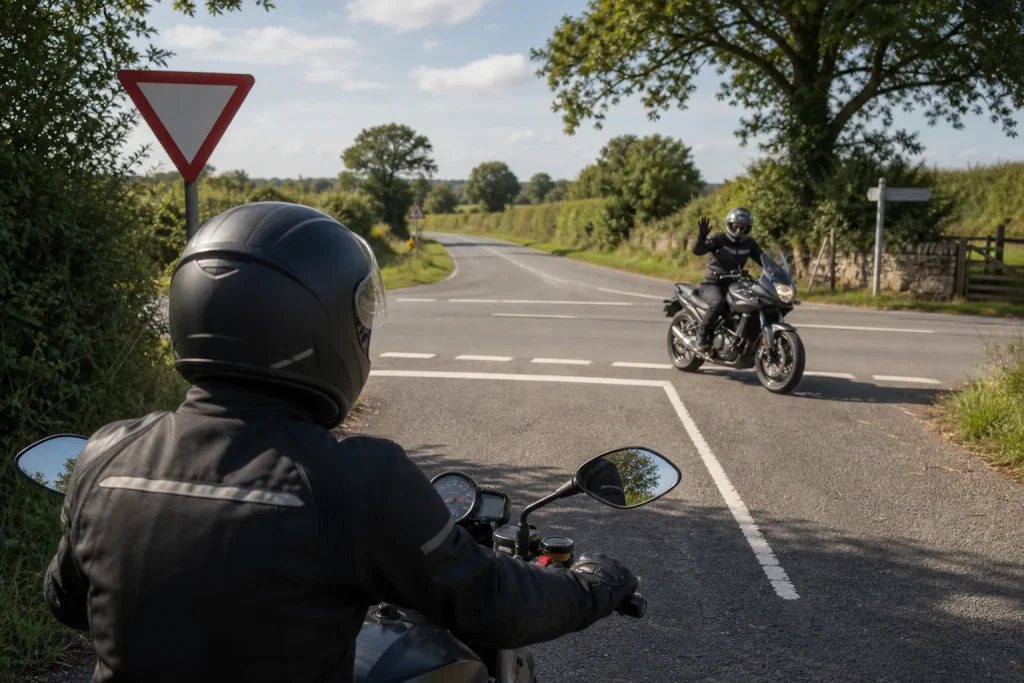
Another rider nods as you wait at a junction. Are they saying hello, thanking you, or asking you to move? Treat the nod as a courtesy, not an instruction. Work out what to do from the road, signs and traffic, following the rules that apply where you are riding.
A nod is a greeting
A nod usually means little more than “I’ve seen you” or “hello”. Among riders, it can be a quiet expression of fellowship. Its meaning depends on the moment, the rider and local custom, so it is not precise enough to direct traffic.
At a junction, a nod might acknowledge that you are waiting or simply answer your greeting. It does not reliably mean “you go first”. The other rider could be looking at a car, a pedestrian or a sign you have not noticed. Distance, glare and movement can make even a clear-looking gesture hard to interpret.
Return a nod if it feels natural and safe, but make your traffic decision separately. Check signs and markings, observe the surrounding traffic and follow current official guidance for your jurisdiction. A friendly gesture cannot settle priority.
Waves and right of way
A wave may be intended as a courtesy, but it does not by itself establish who has priority or make a manoeuvre lawful. Traffic rules differ by jurisdiction, and the full situation matters. Check current local official guidance when you are unsure about a rule; an approved riding instructor can help explain how it applies.
If you are stationary and the situation is already clear, a small wave might acknowledge that you have made room. Avoid waving if you are moving, if several vehicles are involved, or if another road user could mistake your gesture for a signal. A wave cannot make an unsafe gap safe.
If another rider waves you on, assess the road yourself. Do not treat the gesture as permission. Follow local rules and move only if your own observations show that you can do so safely and lawfully. If you cannot tell, stay in a safe, predictable position until you can judge the situation or get appropriate guidance.
Read the whole junction
Use the same judgement you would use without another rider present. Check signs and markings, look for traffic and people crossing, and wait if you cannot see enough to decide. Signal and position yourself as required under local rules, while continuing to observe what others are doing.
Imagine you are waiting at a side-road junction and a rider on the main road nods as they pass. You check the signs and markings, then look for traffic, pedestrians and any obstruction that limits your view. The nod does not change what those checks tell you: you wait while the situation is unclear, then proceed only when the road conditions and the rules allow it. The decision comes from what you can observe, not from guessing at the rider’s meaning.
At a busy junction, give your attention to the whole scene rather than trying to decode every glance. Keep a predictable position and do not creep forward to make another rider decide for you. If a vehicle blocks your view, wait until you can see enough to assess the situation.
Use recognised signals
A nod, wave or head movement is not a substitute for indicators or other signals required for your manoeuvre. A gesture between riders may be invisible to a driver behind you or a pedestrian beside the road. It may also be understood differently from how you intended it.
Use signals in the way required by local rules. Indicators communicate a planned turn or change of direction, but they do not grant priority or remove the need to check before moving. If you are unsure about the rules for a particular manoeuvre, consult current official guidance for your area or ask a qualified instructor.
A brief wave of thanks may be courteous after someone has made room, provided you can give it without compromising control. A nod can acknowledge another rider without taking a hand off the bars. Neither should be used to invite someone into a gap or make up for a missed indicator.
Keep thanks low-key
A nod is often enough. If you are stopped and it is safe, a small hand gesture may be understood, but there is no need to perform one. Keep your attention on the road, and remember that the other rider may not see your response.
If someone slows to let you pass, acknowledge the courtesy when you can, but do not rush into a gap that does not suit you. Nor should you expect a reply. Riders differ in how they greet one another; some nod, some keep their eyes on the road, and some may not have noticed you.
Courtesy works best when it asks nothing in return. Offer a nod because you mean hello, not because you expect the other rider to yield. Thank someone without turning their kindness into an instruction to move.
When gestures are unclear
Choose the interpretation that requires the least assumption: treat an unclear gesture as acknowledgement, keep a predictable position and wait until you can assess the road. Do not try to read intent from a helmet tilt or a hand that might be pointing elsewhere.
Several vehicles may arrive together. One driver might wave you across while another continues moving. A rider may slow without intending to stop, and a pedestrian may assume a vehicle is waiting. A signal can be seen by some people and missed by others, so rely on what you can observe directly and apply the rules for your location.
If another rider appears unsure, give them space and avoid adding a competing gesture. If you are unsure, waiting in a safe place is a sensible choice. The right response depends on the complete traffic situation and local rules, not on the wave alone.
Nods are optional
A nod is a social courtesy, not a riding rule. Some riders enjoy the custom; others do not use it, and many may not notice a greeting while concentrating on traffic. Return one when it is easy and safe, or leave it unanswered without being rude.
Habits differ between places, communities and circumstances. If you are new to a group ride, watch how the group behaves and ask a club organiser or experienced rider about its conventions while parked.
Keep group-specific signals to settings where they have been explained and agreed. A gesture used on a familiar ride may mean nothing to a stranger at a public junction. Use recognised traffic signals and lawful positioning as directed by the rules where you ride.
Let courtesy stay simple
Make your actions predictable. Leave room, avoid abrupt changes of direction and use the signals required for your manoeuvre. Look for pedestrians and other road users as well as the rider who caught your eye. If the junction demands your full attention, skip the nod.
Separate the moment into two questions: “What do the local rules and road conditions require?” and “Would a greeting be safe?” Answer the first from the signs, traffic and current official guidance. Consider the second only when your attention allows it.
A nod can make a shared road feel a little more human without asking either person to guess. Offer it as a greeting, receive it as a greeting, and let observation and the applicable rules guide your next move. If you are unsure, wait somewhere safe and predictable; you can acknowledge the other rider later, when the road no longer needs your attention.
Keep riding this thread
One Bag, One Ride: Packing Around What Must Stay Put
Choose a carry method by sorting your day-ride essentials into what needs quick access, what must…
A Calm Start to the Owner Manual: Find the Pages You Will Revisit
A model-specific manual becomes easier to use when you locate the practical pages before you need…