One Bag, One Ride: Packing Around What Must Stay Put
Choose a carry method by sorting your day-ride essentials into what needs quick access, what must stay stable and what must stay dry.
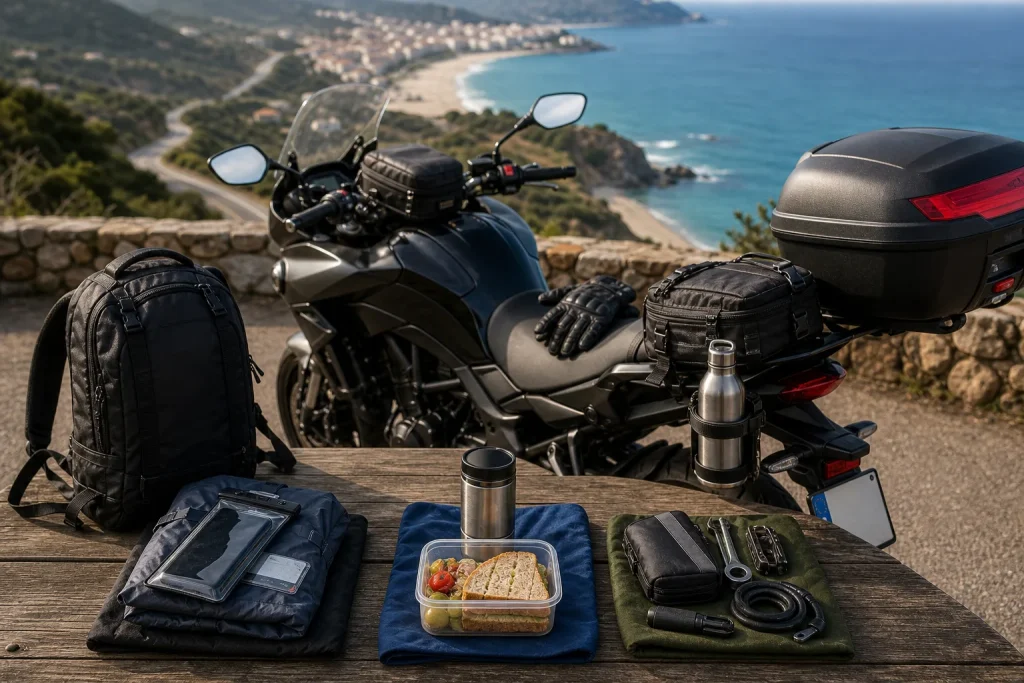
Where should your bag go if you need your gloves at a stop, your lunch to stay upright and your phone to stay dry? Start by sorting the load, not by choosing a bag. On a day ride, the right carrying method keeps essentials secure and protected without getting in your way.
Make three piles on a table: things you may need soon, things that must not shift, and things that must not get wet. Some belongings fit more than one pile. A phone, for instance, needs weather protection and may need to be reachable when parked. Once you can see the priorities, compare a backpack, a tail bag and a top box.
Access first
Ask what you might need before the ride ends. A parking token, water bottle or spare layer may need to be easy to reach; a packed lunch can stay buried. Keep stop-time essentials in a pocket or compartment you can reach while parked, without unpacking the rest of your load.
Reaching for something while moving can distract you, and even a small item can become a hazard if it falls. Stop somewhere safe before handling a phone, map or loose object. Keep anything you may need at a fuel stop in an outside pocket or near the opening, rather than underneath clothes and food.
Say you are riding to a coastal town with a phone, a thin waterproof layer, a flask and a picnic lunch. You put the phone and layer in an inner waterproof pouch near the bag’s opening, the flask in a purpose-made holder that the holder and motorcycle makers both approve for that exact fitment, and the lunch in the main compartment. Before setting off, you check the holder’s instructions and the motorcycle maker’s guidance; if either does not permit that setup, you do not use it and instead pack the flask securely inside a compatible bag. The expected result is that you can reach the phone and layer at a safe stop without disturbing the lunch, while the flask remains contained in an arrangement permitted by the relevant instructions.
Backpack freedom
A backpack suits a light load, a machine without luggage fittings, or a ride that ends on foot. It is easy to carry into a café or office, and you do not need to leave a bag attached to the bike. Choose one with a secure closure, straps that can be shortened and a shape that does not obstruct your view or movement.
Its drawback is that the load moves with your body. A loosely packed bottle or hard object can press against you; wide or dangling straps may catch or flap. Pack dense items close to your back and keep the contents from sliding. Make sure the pack sits comfortably before setting off, then check that you can turn your head and move your arms freely.
A backpack works best when the load is modest and you value taking everything with you. It is less suited to bulky or heavy kit, especially if you would rather not carry it once you arrive.
Tail bag flexibility
A tail bag keeps the load off your shoulders and can be a useful middle ground. Depending on the model and motorcycle, it may attach with straps or a mounting system. Check the makers’ fitting instructions, including where straps may run and what parts must remain clear. Secure the bag firmly, with no loose ends that could reach a wheel, chain, exhaust or controls.
Stability is the deciding factor. Place denser items low and towards the centre, and avoid a lopsided load. Before riding, check that the bag cannot slide sideways or interfere with the seat, passenger space or moving parts. A bag that seems snug when empty may behave differently when packed, so check the fit in its loaded state.
Tail bags vary in how quickly they open and how well they resist rain. An outer pocket can make small items accessible, but do not use it for anything you need to handle on the move. If the bag is not fully waterproof, put vulnerable belongings in a separate dry bag or waterproof pouch. This option suits riders who want luggage capacity without wearing it and are happy to check the attachment before setting off.
Top box order
A top box gives belongings a fixed home on the motorcycle and can be easy to lock away when parked. Its shape works well for items that should remain contained, such as a folded layer, lunch or a small kit. Use the box within the load limits set by its maker, and follow the motorcycle and box instructions for fitting and loading.
Because a box is mounted behind the rider, pack with balance in mind. Keep heavier items low and avoid piling everything at the far end. Close and latch the lid before setting off. A top box may be less convenient for a quick grab if its opening is covered by other luggage, and it does not replace a waterproof inner bag for items that cannot tolerate moisture.
Choose this approach if your motorcycle has a compatible fitting, you want a secure place to leave belongings and you do not need to carry the container around once parked. If the bike has no suitable mount, a top box may involve more fitting work than a one-day ride warrants.
Choose by priority
A small waterproof pouch inside a larger bag can protect a phone or paperwork. For a bottle, use a purpose-made holder only if its maker’s instructions approve the specific attachment and the motorcycle maker’s guidance permits that fitment. Check that the holder is secure and clear of the wheel, chain, exhaust, controls and rider movement. If the instructions do not clearly allow the arrangement, do not fit it; carry the bottle inside a compatible bag instead.
- Check the load size: If it fits comfortably in a backpack and you want to carry it on foot, choose the backpack; if it is bulky or burdensome to wear, use compatible motorcycle luggage instead.
- Check your need to carry the bag: If you want to take everything into a café or office, choose a backpack; if not, consider a tail bag or top box that fits the motorcycle.
- Check tail-bag instructions: If the maker approves the attachment points and the loaded bag stays clear of moving and hot parts, use that setup; if not, choose another compatible luggage option.
- Check the top-box fitting: If the box and motorcycle makers approve the mounting system and loading arrangement, use it within their instructions; if not, do not fit or load the box that way.
- Check weather protection: If the outer bag is not waterproof and an item must stay dry, put it in a waterproof inner pouch; if no suitable pouch is available, choose a different way to carry that item.
- Check access and closure: If essentials are reachable while parked and every pocket and lid closes securely, set off with that arrangement; if anything needs handling on the move or will not stay closed, repack it before riding.
Before leaving, check that the load is closed, secure and clear of your movement and the motorcycle’s moving or hot parts. Sit on the bike in your usual riding position and make sure nothing presses, snags or blocks your view. If an item needs constant adjustment or is awkward to reach, rearrange it before the ride; a safe stop is the right place to fetch something, not a hurried reach on the road.
Keep riding this thread
The Nod at the Junction: Courtesy Without Guesswork
A rider’s nod can be a friendly hello, but it cannot tell you who should go…
A Calm Start to the Owner Manual: Find the Pages You Will Revisit
A model-specific manual becomes easier to use when you locate the practical pages before you need…